
You’ve got a product ready. Now comes the hard part: getting it onto shelves and keeping it there.
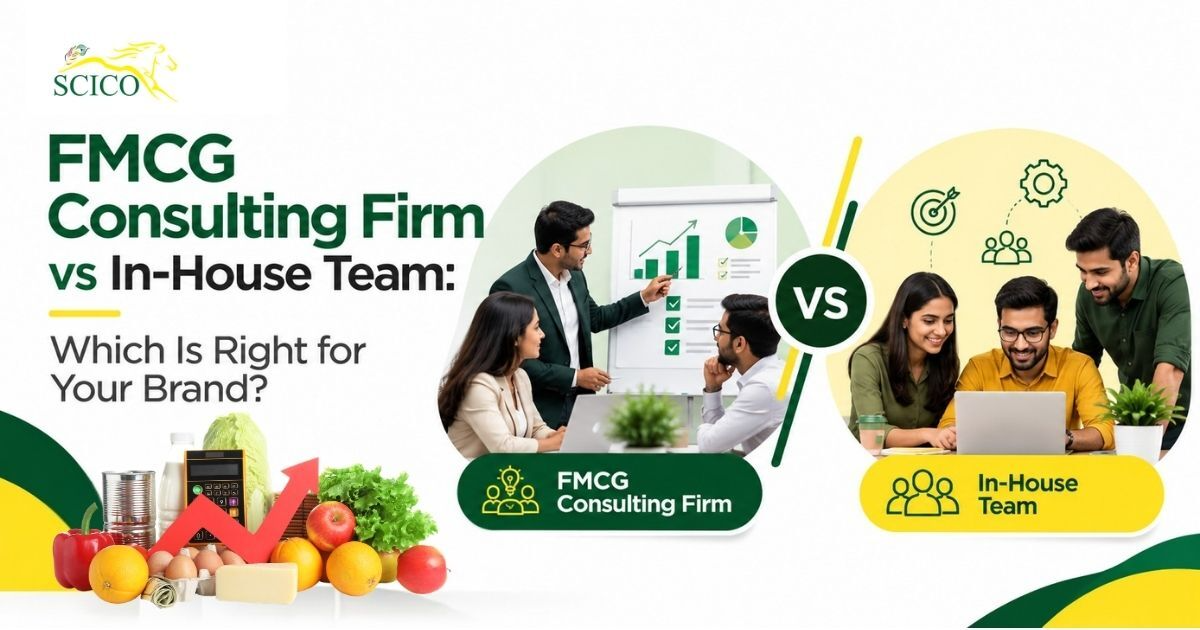
Some founders build their own sales and marketing team. Others bring in an FMCG consulting firm. So how do you settle the FMCG consultant vs in-house team question? It depends on where your brand stands today and where you want it next.
FMCG Consultant vs In-House Team: The Quick Answer
If you’re launching, entering a new market or fixing a stalled brand, an FMCG consulting firm usually gets you moving faster. If you’ve already found your market and need steady daily execution, an in-house team makes more sense.
What an FMCG Consulting Firm Actually Does
A good FMCG consultancy has seen plenty of launches, and a fair few failures too. Typical support covers:
- Go-to-market planning, pricing and margin structures
- Distributor and stockist acquisition
- Modern trade and general trade entry
- Packaging, positioning and product development
You also get speed. An FMCG business consultant can step in within weeks, while hiring a full team can take months. You pay for a set scope, not permanent salaries.
Where an In-House Team Wins
Your own people live with the brand every day. They know every SKU, distributor and complaint. No FMCG business consultant can match that kind of day-to-day familiarity.
An in-house team also suits ongoing work. Sales follow-ups, beat planning and retailer relationships never really end, so it pays to have people on the payroll.
The catch? Recruiting, training and managing a team takes time and money. One wrong sales hire can delay a launch by months.
FMCG Consultant vs In-House Team: A Side-by-Side Look
| Factor | FMCG consulting firm | In-house team |
| Speed to start | Weeks | Months to hire and train |
| Cost structure | Project or retainer fee | Fixed salaries and overheads |
| Market knowledge | Across many brands and categories | Deep knowledge of your own brand |
| Best for | Launches, market entry, turnarounds | Daily execution and long-term growth |
When to Hire an FMCG Business Consultant
Bring in outside help when:
- You’re launching a new product or brand
- Sales have flattened and you can’t see why
- You want to enter a new city, state or channel such as modern trade
- You need distributors but don’t have the contacts
In these moments, an FMCG consultancy gives you a clear plan and people who’ve done it before.
Can You Use Both?
Yes, and many growing brands do. A common setup looks like this. An FMCG consulting firm builds the launch plan, sets up distribution and trains your people. Your in-house team then takes over the day-to-day.
Seen this way, the FMCG consultant vs in-house team debate stops being an either-or choice.
How to Pick the Right FMCG Consulting Firm
Not every FMCG consultancy works the same way. Ask a few simple questions before you sign:
- Have they launched brands in your category?
- Do they help with implementation, or just hand over a report?
- Can they connect you with distributors and retailers?
- Who will actually work on your account?
A good FMCG business consultant should be happy to answer all four.
Conclusion
There’s no single right answer here. Early-stage brands and those facing big moves usually gain the most from an FMCG consulting firm. Established brands with steady sales often do better investing in their own people. If you’re planning a launch, relaunch or market entry, SCICO(Sharp Consulting and Implementing Company) works as an FMCG consultancy that stays involved from planning right through to execution on the ground. Get in touch to talk it through.
FAQs
1. Is an FMCG consulting firm only for new brands?
No. New brands often gain the most, but established companies also hire an FMCG consulting firm to relaunch products, enter new regions or fix falling sales. Any brand facing a big change without the right skills in-house can benefit from outside support.
2. How long does a consultant usually stay with a brand?
That depends on the scope. Some projects cover a single launch and wrap up within a few months. Others run as ongoing retainers, with the consultant reviewing sales and distribution regularly while your internal team handles the daily work on the ground.
3. Will hiring a consultant replace my sales team?
Not usually. A good FMCG consultancy works alongside your people, sharing plans, contacts and processes so your team can carry the work forward. The aim is to build your own capability, not to create a long-term dependence on outside help.
4. What should I prepare before bringing in outside help?
Gather your sales figures, pricing, distributor list and product details. Be clear about what you want, whether that’s a launch, new markets or better margins. Clear goals mean an FMCG business consultant can get to work faster and waste less time.
5. Can small brands afford outside FMCG expertise?
Often, yes. Many small brands find project-based support cheaper than hiring several senior staff at once. You pay for specific work over a set period, which keeps costs predictable and still gives you access to people with years of category experience.
Leave a comment